
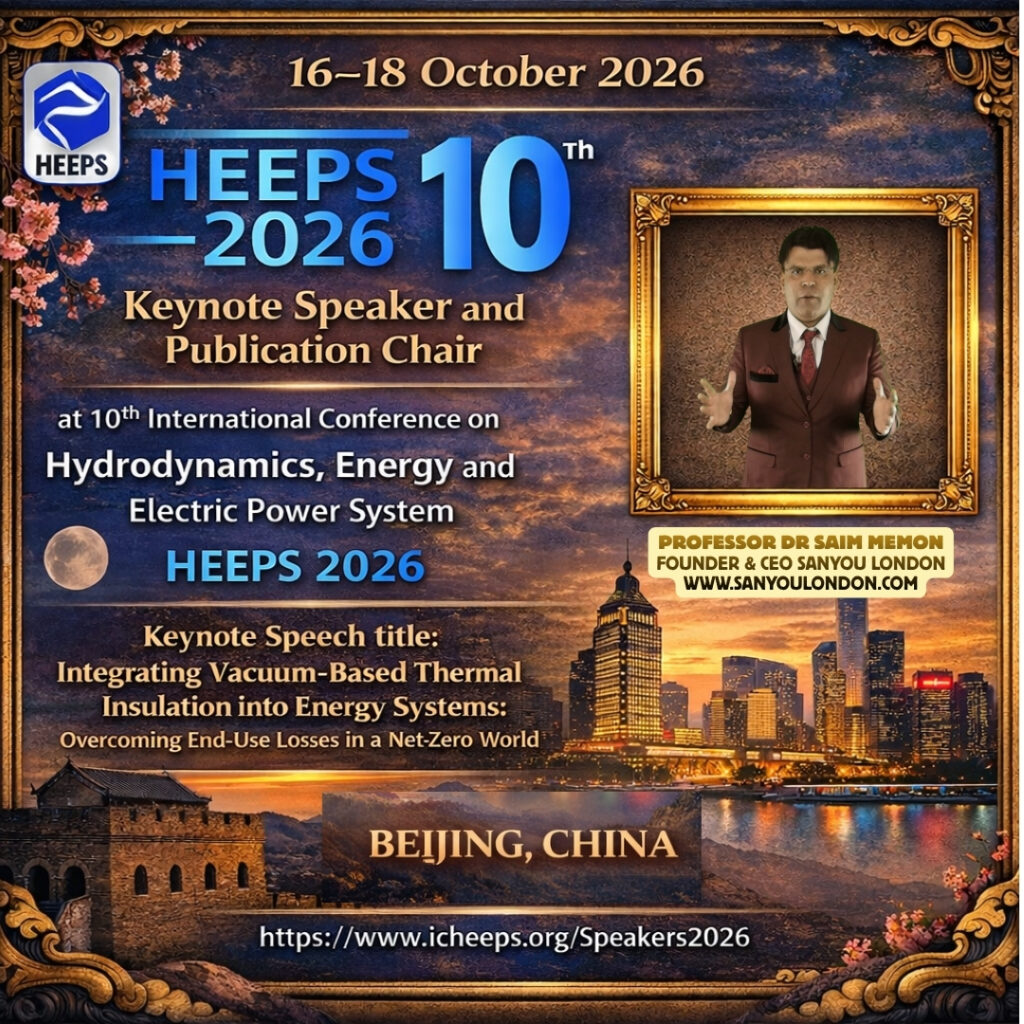
Sanyou London is pleased to share its conference contribution to the 10th International Conference on Hydrodynamics, Energy and Electric Power System, HEEPS 2026, held in Beijing, China, from 16 to 18 October 2026 presented by Professor Saim Memon
At the conference, Sanyou London contributes a keynote titled Integrating Vacuum-Based Thermal Insulation into Energy Systems: Overcoming End-Use Losses in a Net-Zero World. The topic sits naturally within the conference scope, because the official call for papers includes energy-saving technology, energy storage technology, new energy power, smart power, and e-mobility among its relevant themes.
Why does this keynote matter? Because too much of the net-zero discussion still focuses on supply while ignoring where energy is quietly lost after it is generated. In practice, large amounts of useful energy continue to disappear through walls, roofs, glazing, refrigeration systems, pipework, logistics packaging, and transport barriers. That means the real engineering question is not only how to generate cleaner energy, but how to stop wasting it first.
This keynote addresses that problem directly. It presents Sanyou London’s wider platform of ultra-thin vacuum insulation technologies as a technically mature route for reducing end-use losses across buildings, storage, transportation, AI data centres, and wider thermal-management applications. The message is clear: deep energy efficiency depends not only on smarter control, but also on stronger thermal hardware.
The keynote brings together Sanyou London’s key vacuum-insulation solutions, including Vacuum Insulation Panels, VIP, Decorative Integrated Vacuum Insulation Panels, DVIP, Vacuum Insulated Wallpaper, VIW, Vacuum Insulated Curtains, VIC, Vacuum Insulated Heatable Curtains, VIHC, and Vacuum Insulated Bag-or-Box systems, VIBB. Together, these products reflect Sanyou London’s ongoing effort to make low U-values achievable in real projects, under real constraints of space, safety, manufacturability, and cost.
A central strength of this work is that it does not stop at laboratory curiosity. It is framed around TRL 7 to 9, with emphasis on industrialisation, repeatable quality control, and practical deployment. That matters. Many technologies look impressive at prototype level, yet fail to scale into something that universities, developers, contractors, logistics operators, and industrial users can actually procure and implement. Sanyou London’s wider approach is different. It asks whether the technology can move from idea to product, and from product to credible use.
For building applications, this has obvious value. Thin, high-performance insulation can change the economics and practicality of retrofit where conventional thickness is difficult to justify. Readers who want to explore this side further may wish to see What Is a Vacuum Insulation Panel (VIP)? How It Works, Why Our VIP Is “Smart” Insulation: Best-in-Class Performance in Millimetres, and What Happens When You Apply VIP on Concrete, Brick and Cavity Walls?.
For windows and interior comfort, the discussion also connects with the VIC Product Catalogue, Vacuum Insulated Curtain: Thermal Performance & Energy Savings, and Vacuum-Insulated Heatable Curtain (VIHC): DIY Warmth and Insulation for ≈1 kWh. For façades and external envelope upgrades, relevant background includes the DVIP Product Catalogue and Thermal Performance Comparison of DVIP with Conventional Insulation Materials.
For transport, storage, and cold-chain use, the keynote also points to a wider demand-side opportunity. If thermal loss is reduced at source, systems depend less on constant active cooling, oversized equipment, or avoidable energy input. That is why the speech is relevant not only to sustainable buildings, but also to transport logistics, refrigeration, and digital infrastructure. Readers interested in that side may wish to explore VIPs for Trucks & Containers: Cut Fuel, Protect Cargo, and Stabilise Temperature Without Adding Bulk, VIBB: Vacuum-Insulated Bag or Box for Medical, Food and Logistics, and VIPs for AI Factories & Data Centres: Thin Thermal Control for Racks, Pods and Control Boxes.
The conference itself is positioned as a platform for interdisciplinary integration and technological innovation across hydrodynamics, energy, and electric power systems, with support from research and university institutions including University of Agder and Hanjiang National Laboratory. The official publication route also adds academic visibility, as accepted full papers are intended for publication in Journal of Physics: Conference Series and submission to EI Compendex and Scopus.
For Sanyou London, this keynote and publication-chair role together reflect something broader than conference presence alone. They show the company’s continued position at the point where academic knowledge, industrial R&D, and practical energy-saving implementation meet. In a net-zero world, the most useful technologies are not those that merely sound advanced; they are the ones that reduce waste deeply, scale credibly, and make engineering sense across real sectors.
Readers who want a broader overview can visit the Department of Products and Sales, the Department of Industrial Research and Development, the Videos page, and the Articles page. For technical discussions, collaboration, speaking opportunities, or commercial enquiries, Sanyou London welcomes contact through its Contact page.






Share