
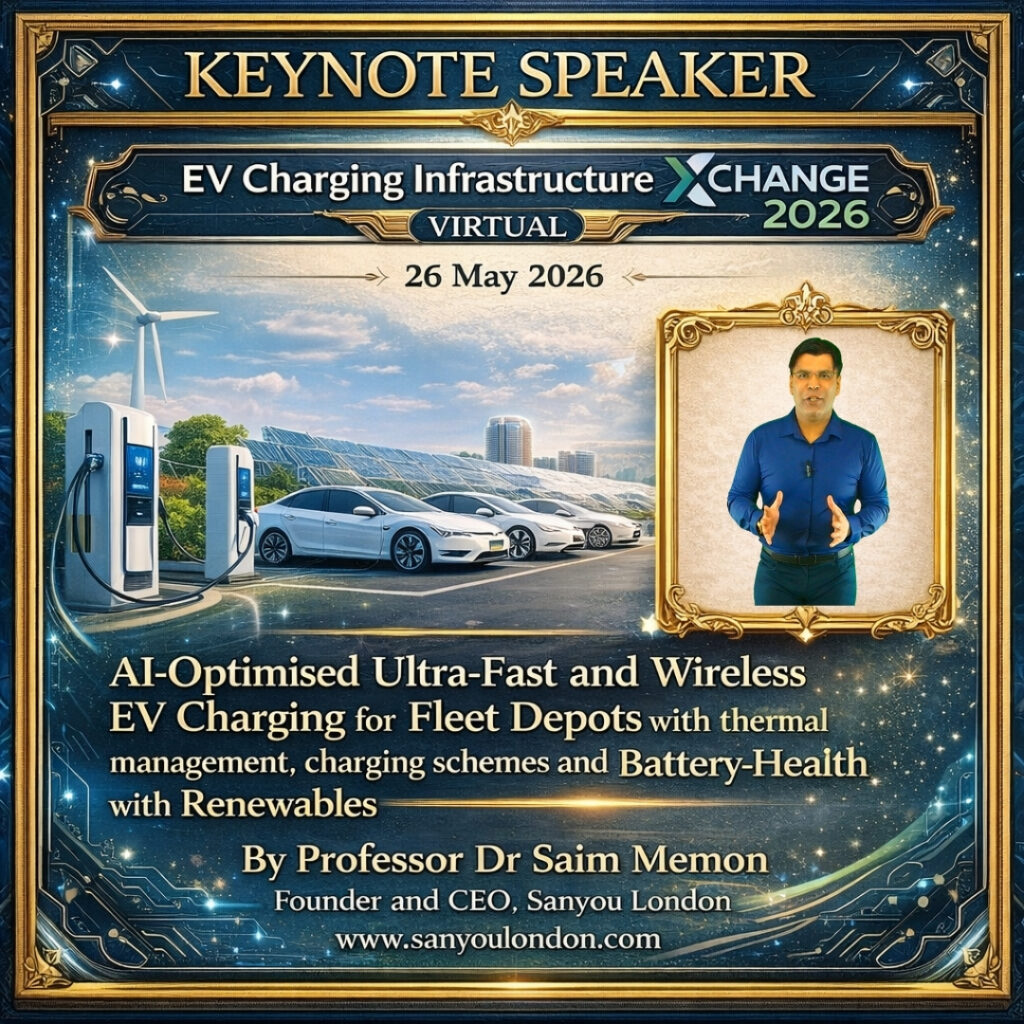
Sanyou London is pleased to share a new keynote contribution at EV Charging Infrastructure Xchange 2026, a virtual global conference that focuses on the next stage of EV charging deployment, where the real challenge is no longer simply installing chargers, but operating reliable, scalable, and commercially defensible charging systems.
At the centre of this contribution is Professor Saim Memon, Founder and CEO of Sanyou London, whose keynote speech is titled:
AI-Optimised Ultra-Fast and Wireless EV Charging for Fleet Depots with Thermal Management, Charging Schemes and Battery Health with Renewables
This keynote addresses a serious practical question. When fleet electrification scales up, what actually determines performance: charger power alone, or the wider system around it? In reality, depot charging success depends on queue control, charging profiles, thermal management, battery-health protection, renewable integration, and power-quality governance working together rather than in isolation.
That is the core strength of this keynote. It does not treat EV charging as a single hardware problem. It treats it as an operational energy-system problem.
Why this keynote matters
The wider EV market has already moved beyond the early stage of simply adding more chargers. What matters now is whether charging infrastructure works efficiently under pressure, during peak demand, under uncertain vehicle arrivals, and within real grid and thermal limits. That is exactly where this keynote sits.
Sanyou London’s conference contribution highlights a practical depot-charging architecture for centralised charging stations supplied by the utility grid together with solar PV and wind input, designed to support high fleet throughput during busy operating periods. It also introduces a queue-aware AI decision framework that jointly considers charging time, charging-profile selection, charging capacity, and per-vehicle queuing delay.
In simple terms, the work asks a hard but necessary engineering question: how does a fleet depot keep vehicles moving, batteries protected, and energy resources managed intelligently when the real world refuses to behave like a perfect timetable?
Key technical highlights
The keynote highlights several important themes:
- A practical charging architecture for fleet depots that combines grid supply with renewable input for stronger throughput and better operating resilience.
- An AI-led decision engine that selects charging schemes and manages delay, rather than leaving performance to static scheduling.
- Monte Carlo modelling to reflect uncertain EV arrivals, making the charging strategy more defensible under real operational conditions.
- Benchmark-backed optimisation performance, with the proposed method showing stronger total-time reduction than comparison methods during peak-hour conditions.
- Thermal-management thinking that scales, using micro-channel cooling with temperature and humidity awareness to protect battery health during ultra-fast charging.
- Waste-heat utilisation pathways through phase change material storage and magneto-thermoelectric conversion concepts.
- Wireless charging implications, including how temperature affects system performance and what control strategies help reduce risk.
- Power-quality governance measures to reduce harmonic distortion and protect voltage quality when renewables and smart-grid inverters are integrated.
What makes this contribution distinctive
A great many EV charging discussions remain too narrow. They focus on charger count, rated power, or headline speed, but they do not fully confront the interaction between battery ageing, charging congestion, environmental conditions, renewable intermittency, and electrical quality.
This keynote takes a broader and more useful view. It connects fast charging, wireless charging, thermal management, scheduling logic, and battery-health thinking into one engineering conversation. That matters for fleet operators, charging-network planners, utilities, OEMs, transport authorities, and smart-infrastructure decision-makers who need solutions that work beyond the laboratory.
It also reflects Sanyou London’s wider interest in applied innovation across energy systems, thermal management, and industrially relevant engineering problems. Although the company is widely recognised for its advanced vacuum insulation technologies, the keynote shows the same broader mindset: solve energy and performance problems where conventional thinking usually stops.
Why this is relevant to Sanyou London’s wider direction
For Sanyou London, this keynote is more than a conference appearance. It shows how advanced thinking in energy systems increasingly depends on integration across disciplines. Charging speed alone is not enough. Thermal control matters. Battery health matters. Queue logic matters. Renewable coordination matters. Power quality matters.
That same systems-thinking approach also sits behind the company’s wider Department of Industrial Research and Development, where engineering problems are approached not only from a product angle, but from the viewpoint of practical implementation, operational efficiency, and real-world performance.
Readers interested in Sanyou London’s broader work on thermal performance, transport applications, and intelligent energy-saving systems may also find these resources useful:
- Flexible Vacuum Insulation Panels: Real Energy Savings for Buildings, Transport, EVs, and Electronics
- Can Flexible Vacuum-Insulation Panels Boost EV Battery Life and Cabin Comfort?
- Vacuum Insulation Panel Flexible | VIP | Sanyou London
- Can Flexible Vacuum-Insulation Panels Boost EV Battery Life & Cabin Comfort? | Prof. Dr. Saim Memon
Final note
Sanyou London sees XCHANGE 2026 as a strong platform for sharing technically serious thinking on the future of EV charging infrastructure. As electrified transport moves further into large-scale fleet operation, the industry needs more than faster chargers; it needs smarter charging logic, stronger thermal control, healthier batteries, cleaner grid interaction, and better use of renewable energy.
For collaboration, technical discussion, consultancy, speaking opportunities, or product and innovation enquiries, readers can visit the Sanyou London website, explore the Department of Products and Sales, or contact the company directly through its enquiry page.






Share