
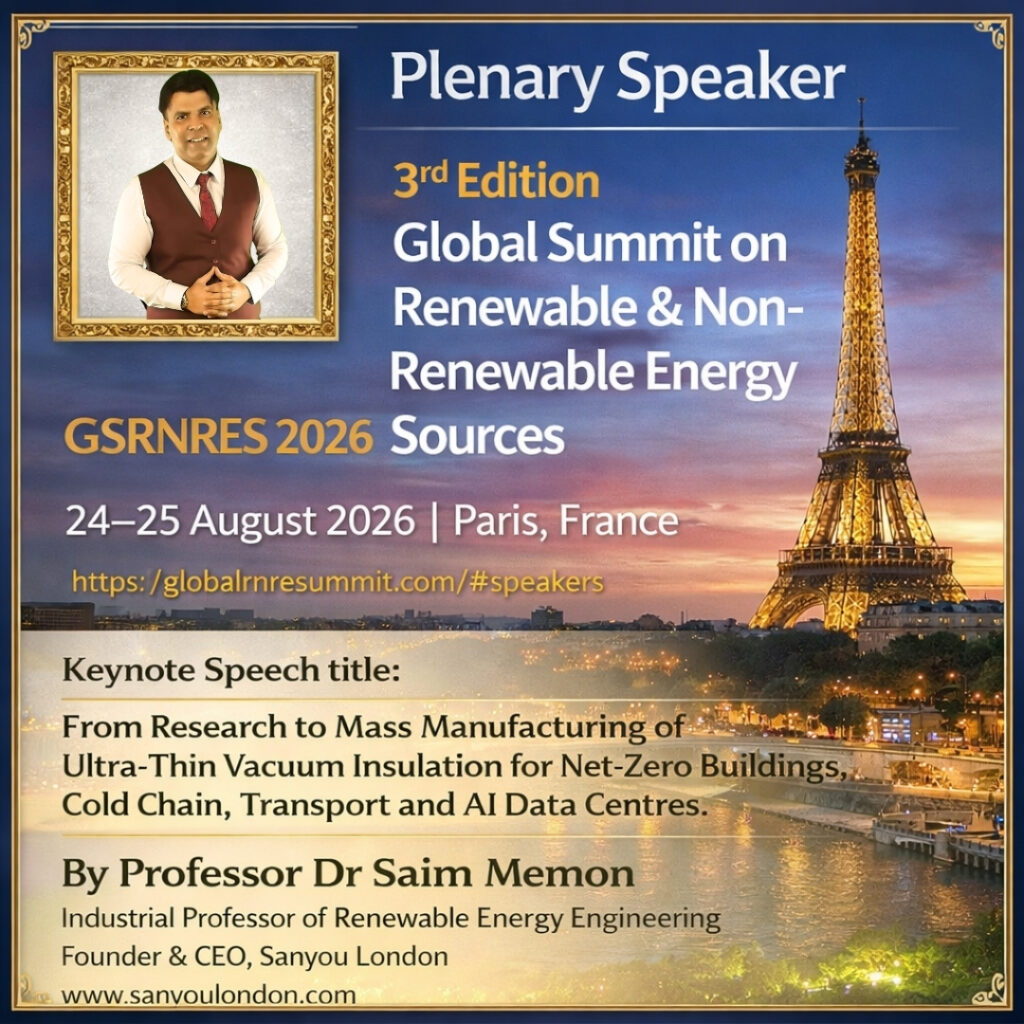
Sanyou London is pleased to share an important international conference contribution at the 3rd Edition Global Summit on Renewable & Non-Renewable Energy Sources, GSRNRES 2026, held in Paris, France, from 24 to 25 August 2026. The official summit website presents Professor Dr Saim Memon as a Plenary speaker, and the same summit also features a Welcome Address from him as Conference Chair.
At the summit, Sanyou London presents a plenary speech titled From Research to Mass Manufacturing of Ultra-Thin Vacuum Insulation for Net-Zero Buildings, Cold Chain, Transport and AI Data Centres.
This is an important subject, because many sustainability targets still fail at the point where real energy is lost rather than where policy language sounds strong. Buildings continue to leak heat through envelopes, glazing zones, and weak retrofit details. Refrigeration, cold-chain packaging, and transport systems continue to carry avoidable thermal losses. At the same time, AI data centres and industrial AI facilities are pushing electricity demand and cooling intensity upwards. In that setting, the question is no longer whether energy efficiency matters. The real question is which technologies are sufficiently mature, scalable, and manufacturable to reduce demand-side losses in the real world.
That is where this plenary speech becomes especially relevant. It does not present vacuum insulation as a laboratory curiosity. It presents it as a route from research to mass manufacturing, which is a far more serious and commercially meaningful proposition.
Why does this summit matter?
GSRNRES 2026 positions itself as a global forum for researchers, industry leaders, policymakers, and students working across renewable and non-renewable energy systems. The official summit themes include energy storage and smart grids, climate-change mitigation, energy efficiency and demand-side management, and net-zero pathways. That makes this conference a very suitable platform for discussing ultra-thin vacuum insulation as part of a wider energy-systems solution rather than as a niche materials topic.
What makes this plenary speech stronger than a standard conference talk?
The answer lies in its emphasis on mass manufacturing. Many innovations sound impressive at prototype stage, yet far fewer are developed with genuine design-for-manufacture logic, scalable sealing methods, in-line vacuum screening, traceability, batch-level quality control, and deployable product architectures. This plenary speech makes a more serious argument: performance must become a factory-controlled outcome, not a one-off demonstration.
That is a crucial difference. It speaks directly to universities, industrial partners, manufacturers, real estate developers, architects, contractors, suppliers, distributors, and policy-facing decision-makers who need technologies that can be procured, repeated, and deployed at scale.
What is Sanyou London presenting?
The speech brings together Sanyou London’s broader platform of ultra-thin vacuum insulation technologies, including:
- Vacuum Insulation Panels, VIP
- Decorative Integrated Vacuum Insulation Panels, DVIP
- Vacuum Insulated Wallpaper, VIW
- Vacuum Insulated Curtains, VIC
- Vacuum Insulated Heatable Curtains, VIHC
- Vacuum Insulated Bag-or-Box systems, VIBB
Taken together, these technologies reflect one strategic aim: to achieve low thermal transmittance in millimetres rather than centimetres, while still remaining practical for real projects and real supply chains.
Why is the “research to manufacturing” message so important?
Because climate mitigation needs solutions that survive contact with reality. A good research idea is not enough on its own. The technology must also survive manufacturing constraints, transport, installation, durability expectations, fire requirements, quality assurance, and commercial scrutiny.
That is why this plenary contribution stands out. It connects invention, engineering, manufacturability, and deployment into one line of argument. In other words, it asks not only whether vacuum insulation works, but whether it can work repeatedly, reliably, and commercially.
Why do buildings, cold chain, transport, and AI data centres belong in the same speech?
At first glance, these sectors seem different. In practice, they share a common problem: avoidable thermal loss.
In buildings, that loss raises heating and cooling demand. In cold-chain systems, it threatens payload stability and increases dependence on active cooling. In transport, it pushes energy use and thermal-management burden upwards. In AI data centres, it adds pressure to cooling infrastructure and electricity demand. The technical forms differ, but the thermodynamic problem is familiar. That is why ultra-thin vacuum insulation can sit across all these sectors with a single core purpose: reduce heat transfer where conventional materials become too bulky, too limited, or too compromised.
Readers who want a broader technical background can explore:
- What Is a Vacuum Insulation Panel (VIP)? How It Works
- Why Our VIP Is “Smart” Insulation: Best-in-Class Performance in Millimetres
- Flexible Vacuum Insulation Panels: Real Energy Savings for Buildings, Transport, EVs, and Electronics
- VIPs for AI Factories & Data Centres: Thin Thermal Control for Racks, Pods and Control Boxes
- VIBB: Vacuum-Insulated Bag or Box for Medical, Food and Logistics
What does this mean for the market?
It means Sanyou London is not only speaking about technical performance. It is speaking about industrial readiness. That matters commercially. Buyers, partners, and specifiers need to know whether a product family can move beyond research language into procurement language. They need evidence of repeatability, product logic, and application fit.
For that reason, the following resources are also especially relevant:
- VIP Product Catalogue
- VIW Product Catalogue
- VIC Product Catalogue
- DVIP Product Catalogue
- VIBB Product Catalogue
- Department of Products and Sales
- Department of Industrial Research and Development
Why is this conference appearance especially valuable?
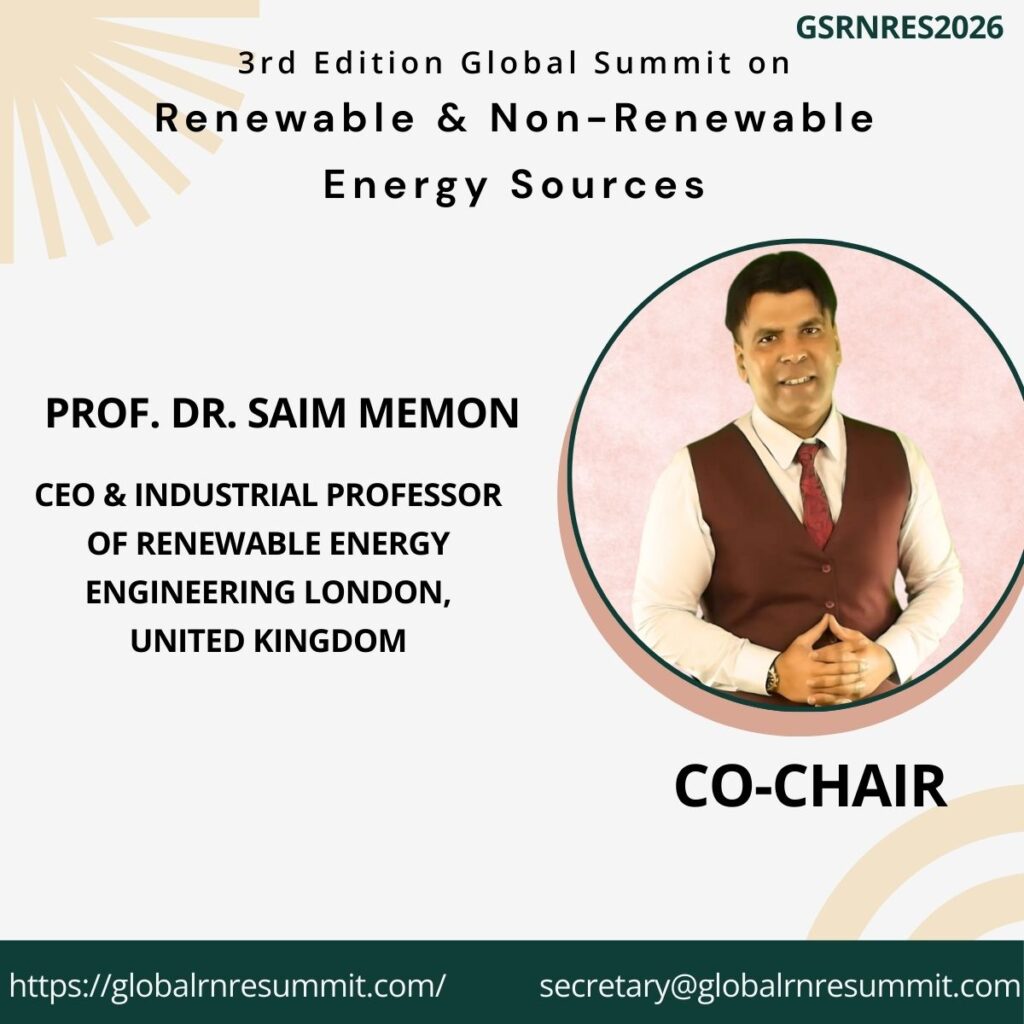
Because the summit website itself places Professor Dr Saim Memon at the centre of the event in two ways: as a Plenary speaker and through a Welcome Address by Conference Chair. That gives the conference contribution a stronger level of public visibility and authority than a routine invited talk.
For Sanyou London, this is not only a speaking engagement. It is a public signal that the company’s work on vacuum insulation is being positioned within a global conversation about affordability, security, sustainability, and real engineering deployment. It also supports the company’s wider message that meaningful energy progress depends on reducing waste at source, not merely managing the consequences afterwards.
Final note
Sanyou London sees GSRNRES 2026 as an important platform for showing that ultra-thin vacuum insulation is no longer only a research idea. It is increasingly a manufacturable, quality-controlled, deployment-ready route for reducing energy loss across buildings, cold chain, transport, and AI-driven thermal environments.
For universities, industrial institutions, developers, logistics operators, architects, contractors, local suppliers, and distributors seeking serious next-generation thermal solutions, Sanyou London welcomes collaboration and enquiries through its Contact page, its Articles page, and its wider Videos page.






Share