
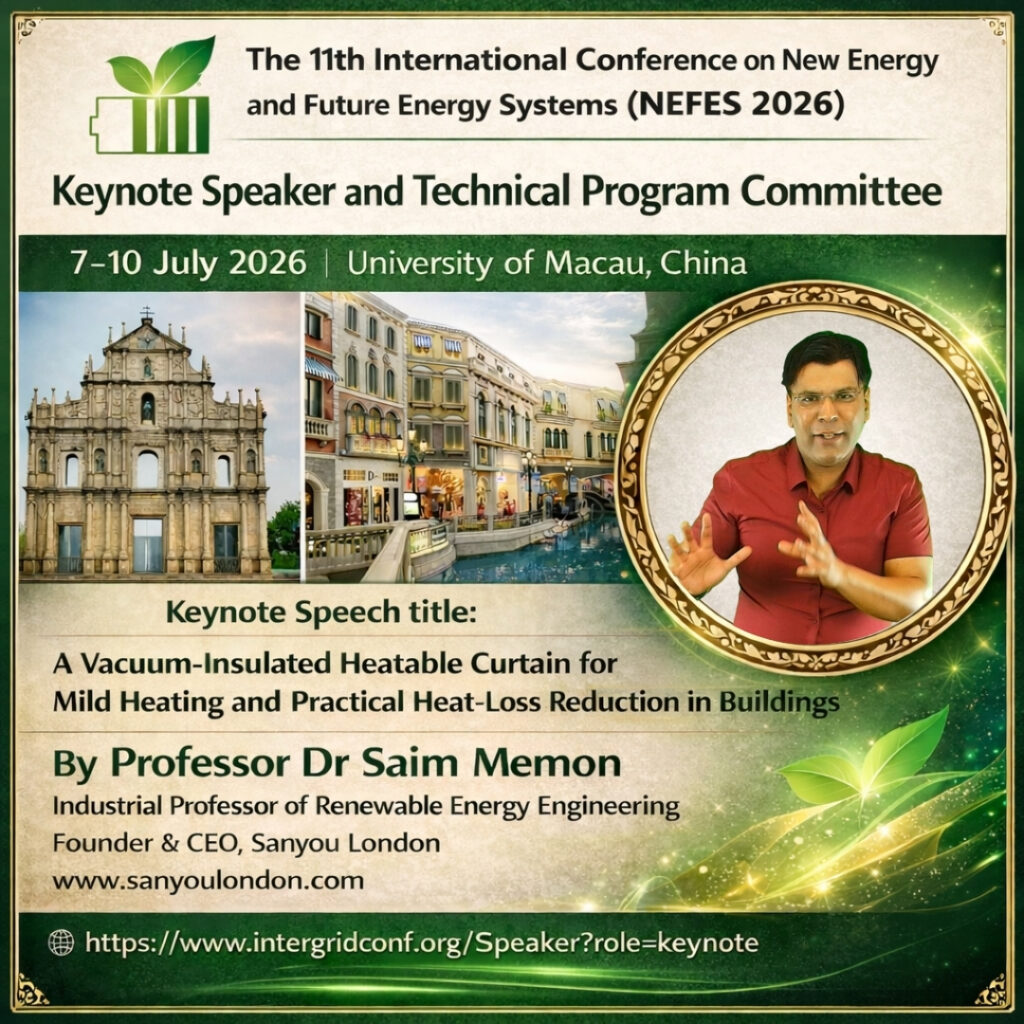
Sanyou London is pleased to share its keynote contribution to the 11th International Conference on New Energy and Future Energy Systems, NEFES 2026, presented from 7 to 10 July 2026 at City University of Macau, in Macao, China. The official conference website presents Professor Dr Saim Memon as a keynote speaker for NEFES 2026 and as a Technical Program Committee Chair for the conference.
At NEFES 2026, Sanyou London presents a keynote titled A Vacuum-Insulated Heatable Curtain for Mild Heating and Practical Heat-Loss Reduction in Buildings. The subject fits the conference well. The official NEFES website describes the event as a platform for researchers and practitioners working across new energy and future energy systems, with keynote speeches, invited speeches, oral presentations, and posters forming part of the programme.
Why does this keynote matter? Because many buildings still waste energy through a simple and familiar weakness: heat loss at windows and glazing zones. In practice, people often respond by raising the room temperature, which increases energy use across a wider area than necessary. Sanyou London’s keynote addresses a more intelligent question: can local comfort and heat-loss reduction be tackled together, in one practical product, without replacing windows or carrying out disruptive refurbishment?
That is where the Vacuum Insulated Heatable Curtain, VIHC becomes important. Sanyou London’s own product and article pages present VIHC as the world’s first vacuum-insulated heatable curtain, combining a vacuum-insulated layer with gentle radiant heating, aimed at improving local comfort while reducing window-side heat loss. The company’s published material also describes low-power operation at about 1 kWh for three hours, which gives the product a clear practical angle rather than a purely theoretical one.
This matters because mild heating is not the same as heating an entire building aggressively. The principle is much more targeted. Instead of pushing more heat into the full room and accepting ongoing losses through the glazing line, the idea is to support comfort where it is needed while reducing the underlying loss at the same time. That is one reason this keynote feels relevant to both energy engineers and real estate decision-makers. It links comfort, efficiency, and retrofit practicality in a way that many conventional heating discussions do not.
The wider technical context also matters. Sanyou London’s published VIHC and VIC materials describe the curtain platform as a very thin insulating system within a familiar curtain format. Its related Vacuum Insulated Curtain, VIC article reports a whole-curtain conductivity of about 13.08 mW·m⁻¹·K⁻¹ and a U-value of about 1.87 W·m⁻²·K⁻¹, while the VIHC article explains how the heatable variant builds on that insulation logic with added gentle radiant warmth. In other words, the keynote is not only about heating; it is about coupling low-power warmth with real thermal resistance.
For NEFES 2026, that is a useful contribution. New and future energy systems are not only about how energy is generated or stored; they are also about how intelligently it is used. If heat is wasted at the building envelope, then the whole energy system has to work harder downstream. Reducing loss at source is therefore one of the most practical ways to improve efficiency, affordability, and comfort together. The official conference page also states that accepted papers will be published in IET Conference Proceedings and indexed by Ei Compendex and Scopus, which adds academic weight to the event.
For readers who want to understand the product direction behind this keynote, several Sanyou London resources are especially relevant. The VIHC product page, the article Vacuum-Insulated Heatable Curtain (VIHC): DIY Warmth and Insulation for ≈1 kWh, and the article Vacuum Insulated Curtain: Thermal Performance & Energy Savings give a fuller picture of how the concept works and why it differs from ordinary curtains or space-heating habits.
Readers may also find the following pages useful:
Department of Products and Sales,
Department of Industrial Research and Development,
Which Vacuum-Insulated Solution Fits Your Project?, and
Will the Vacuum-Insulated Heatable Curtain Warm Your Home for Just 1 kWh?.
Sanyou London sees this keynote as part of a wider mission: to show that realistic energy progress often comes from solving ordinary losses well. A vacuum-insulated heatable curtain may sound simple at first glance, yet the engineering idea behind it is serious, practical, and highly relevant to buildings that need better comfort and lower heat loss without major structural change.
For universities, housing providers, retrofit professionals, architects, contractors, local suppliers, and distributors interested in practical next-generation thermal solutions, Sanyou London welcomes enquiries through its Contact page and its wider Products and Sales page






Share