
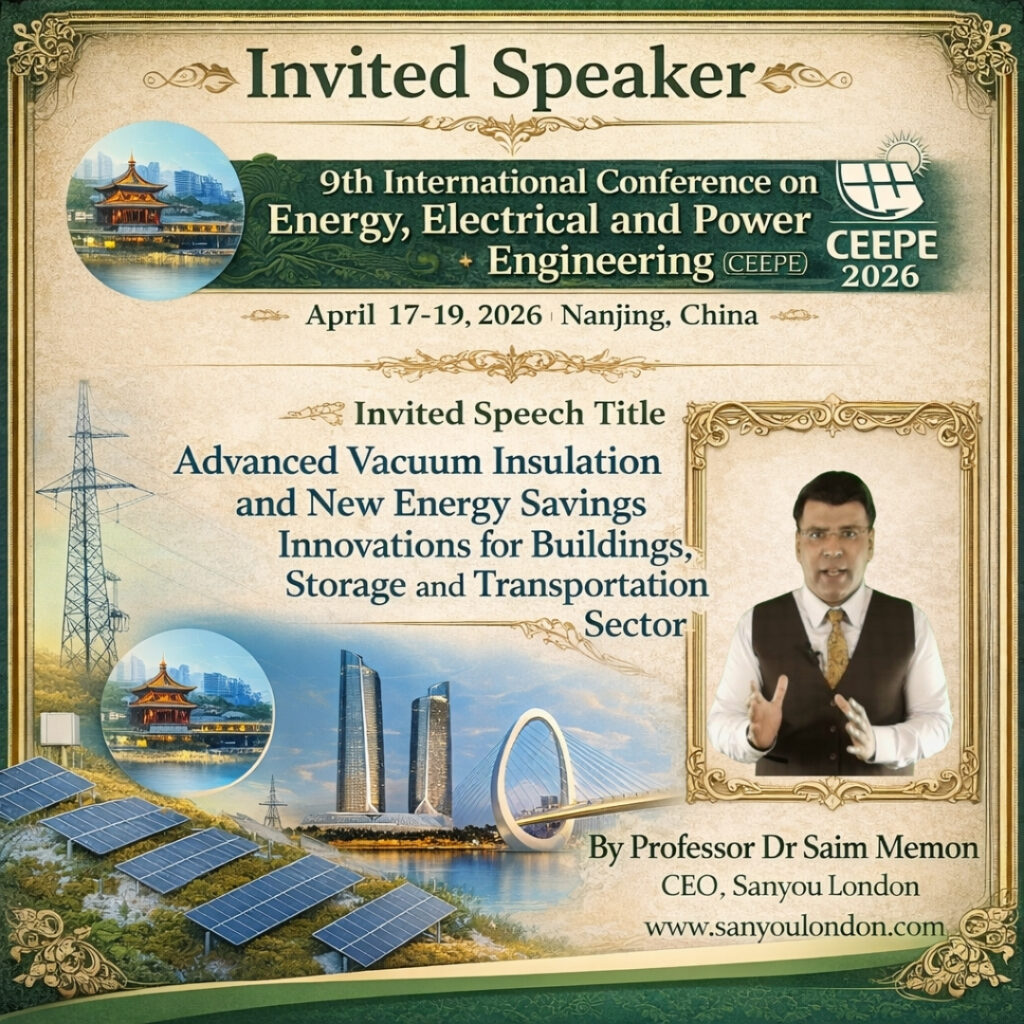
Sanyou London shares its invited speech at CEEPE 2026 in Nanjing, highlighting advanced vacuum insulation innovations for buildings, storage, and transport.
Sanyou London is pleased to share its invited academic contribution to the 9th International Conference on Energy, Electrical and Power Engineering, CEEPE 2026, held in Nanjing, China, from 17 to 19 April 2026.
At the conference, Professor Saim Memon, CEO of Sanyou London, presents an invited speech titled Advanced Vacuum Insulation and New Energy Savings Innovations for Buildings, Storage and Transportation Sector.
This matters because the energy challenge is still not only about how power is generated; it is also about how much of that energy is quietly lost afterwards through walls, roofs, glazing, pipework, refrigeration systems, storage units, and transport enclosures. In practical terms, too much useful energy still disappears through weak thermal design, and many conventional insulation materials struggle to deliver very low U-values without adding thickness, complexity, material bulk, or wider fire and retrofit constraints.
What is the speech about?
The invited speech brings together Sanyou London’s wider portfolio of ultra-thin vacuum insulation technologies and explains how these innovations address real demand-side energy loss across several sectors. The presentation covers the company’s Flexible Vacuum Insulation Panel, VIP, Decorative Integrated Vacuum Insulation Panel, DVIP, Vacuum Insulated Wallpaper, VIW, Vacuum Insulated Curtain, VIC, Vacuum Insulated Heatable Curtain, VIHC, and Vacuum Insulated Bag or Box, VIBB.
Taken together, these technologies show one clear direction: high thermal performance in millimetres, not centimetres.
Why is that technically important?
The technical case is simple, but serious. If insulation remains too thick, too awkward, too disruptive to install, or too limited in application, then large parts of the market will delay action. That is especially true in retrofit buildings, refrigerated transport, compact storage systems, façade upgrades, and thermally sensitive industrial environments.
Sanyou London’s vacuum insulation approach is designed to challenge that limitation. By reducing convective and gaseous conductive heat transfer through a low-pressure internal environment, these systems aim to deliver strong thermal resistance in very slim formats. In the speech, representative examples include 15 mm fibreglass VIPs with thermal conductivity as low as 2.5 mW·m⁻¹·K⁻¹ and approximate U-value performance around 0.16 W·m⁻²·K⁻¹, as well as wider applications across façades, interior retrofits, glazing-related heat loss reduction, cold-chain storage, and transport thermal protection.
What does the speech highlight across the product range?
For building envelopes, the presentation explains how vacuum insulation can help reduce avoidable losses through walls, façades, and glazing zones where space is limited but performance expectations are rising.
For example, the Vacuum Insulated Wallpaper, VIW is positioned as an ultra-thin internal retrofit option, while the Decorative Integrated Vacuum Insulation Panel, DVIP combines decorative external finishing with integrated thermal insulation in one system. The Vacuum Insulated Curtain, VIC and the Vacuum Insulated Heatable Curtain, VIHC extend that thinking to windows and interior comfort, where thermal control often remains one of the weakest points in occupied spaces.
For transport, storage, and cold-chain use, the speech highlights the role of VIBB systems and wider VIP solutions in reducing temperature instability without excessive bulk or constant reliance on active cooling.
Why does this conference matter for Sanyou London?
CEEPE 2026 sits within the wider energy, electrical, and power engineering space, with attention to clean energy development, smart grids, energy storage, and new power systems. That makes it a strong setting for Sanyou London to place vacuum insulation within a broader technical conversation, not merely as a product story, but as part of the deeper engineering question of how energy is actually preserved, managed, and used efficiently.
This is important for universities, industrial researchers, developers, architects, contractors, local suppliers, and distributors alike. A good insulation system should not only look impressive in a lab sheet; it should make practical sense in the real world, where installation constraints, space limitations, operating temperatures, durability, and commercial implementation all matter.
Where can readers explore more?
Readers who want a broader overview of Sanyou London’s work can visit the Department of Products and Sales, the Department of Industrial Research and Development, the company’s Videos page, and its Articles page.
A few particularly relevant resources include:
- What Is a Vacuum Insulation Panel (VIP)? How It Works
- Flexible Vacuum Insulation Panels: Real Energy Savings for Buildings, Transport, EVs, and Electronics
- Which Vacuum-Insulated Solution Fits Your Project?
- Can Vacuum Insulation Panels Slash Energy Loss by 98 %?
- Overview of Sanyou London Pvt Ltd
Final note
Sanyou London sees this invited conference contribution as part of a larger mission: to move vacuum insulation from specialist discussion into practical deployment across buildings, storage, transport, and other thermally demanding sectors where thin, high-performance energy-saving solutions are increasingly needed.
For technical discussions, product enquiries, collaboration, or commercial interest, readers can contact Sanyou London through its Contact page.






Share