
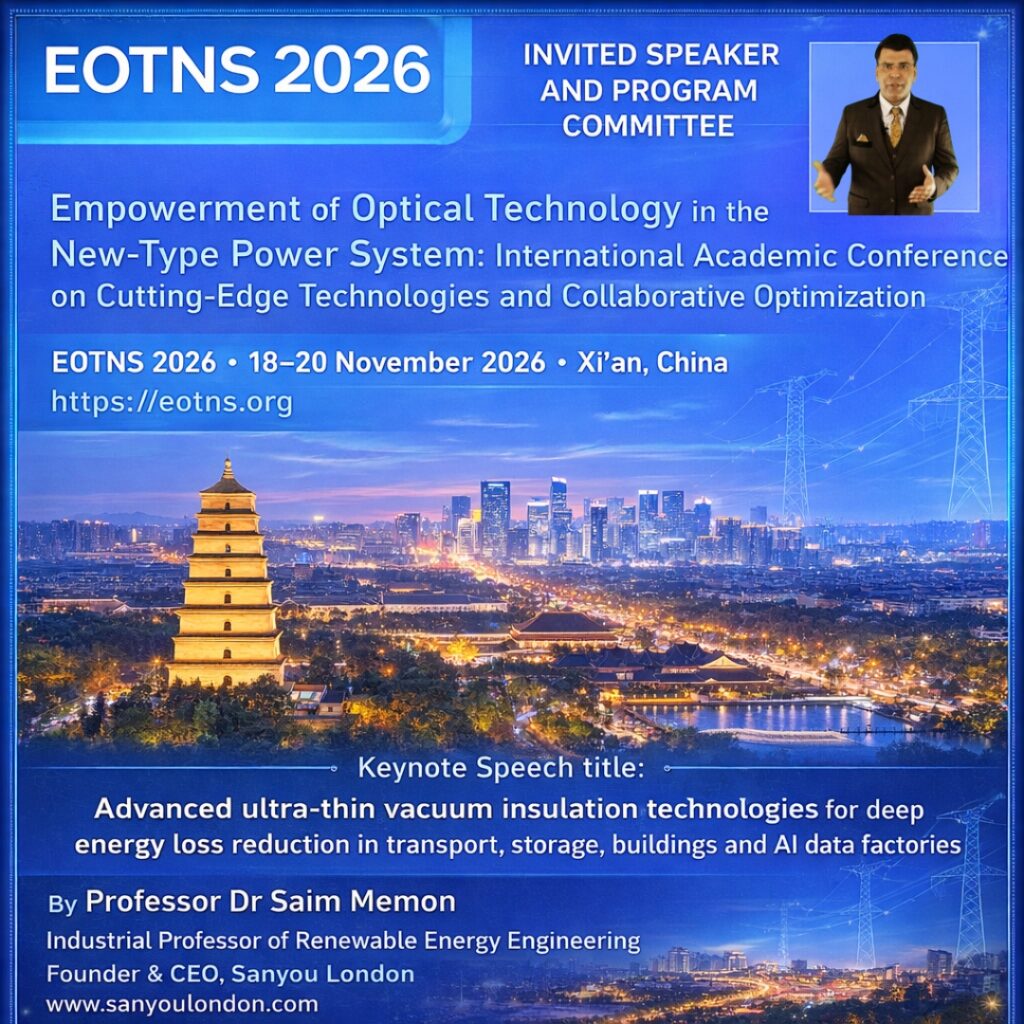
Sanyou London is pleased to share its invited conference contribution to the Empowerment of Optical Technology in the New-Type Power System: International Academic Conference on Cutting-Edge Technologies and Collaborative Optimization, EOTNS 2026, held in Xi’an, China, from 18 to 20 November 2026. The official conference website presents EOTNS 2026 as a platform focused on optical technology, intelligent power systems, optical sensing, multi-energy coordination, digital twins, and power data centres. Professor Dr Saim Memon presents this engagement on his public speaking, honours, and publications pages as an invited speaker and program-committee role for EOTNS 2026.
At the conference, Sanyou London presents an invited speech titled Advanced ultra-thin vacuum insulation technologies for deep energy loss reduction in transport, storage, buildings and AI data factories. This is a timely and strategically intelligent topic, because too much of the energy debate still concentrates on generation, while large avoidable losses remain on the demand side, hidden in envelopes, storage systems, transport barriers, refrigeration lines, chilled-water systems, and thermally stressed digital infrastructure. That makes this speech directly relevant to the conference’s wider concern with optimisation, intelligent systems, and real engineering performance.
Why does this conference matter for Sanyou London?
Because EOTNS 2026 is not a routine materials event. It sits at the intersection of optical technology, power systems, intelligent operation, and system-level integration. That matters. It means the audience is already thinking about sensing, diagnostics, communication, optimisation, and infrastructure performance. Sanyou London’s contribution adds the missing but essential physical layer: if thermal losses remain high, then even the best sensing, control, and digital optimisation end up managing inefficiency rather than removing it. That connection is an interpretation drawn from the conference themes and your speech topic, but it is a technically reasonable one.
What is the central message of the speech?
The message is simple, but powerful: deep energy-loss reduction begins where heat is leaking, not where dashboards are measuring it afterwards. Sanyou London’s wider platform of Vacuum Insulation Panels, VIP, Decorative Integrated Vacuum Insulation Panels, DVIP, Vacuum Insulated Wallpaper, VIW, Vacuum Insulated Curtains, VIC, Vacuum Insulated Heatable Curtains, VIHC, and Vacuum Insulated Bag-or-Box systems, VIBB is built around that principle: achieve high thermal resistance in millimetres rather than centimetres, while keeping the systems practical for real deployment. Sanyou London’s own product and article pages present VIHC as the world’s first vacuum-insulated heatable curtain and describe the wider portfolio as applicable across buildings, transport, EVs, electronics, cold chain, and AI data centres.
Why discuss vacuum insulation at a conference about optical technology and power systems?
Because next-generation power systems are not only electrical; they are also thermal, digital, and operational. The official EOTNS themes include optical sensing, intelligent operation and maintenance, power data centres, and digital twins. Those are all environments where thermal stability matters. A sensor reads better when its environment is stable. A control system works better when the physical system is not continuously fighting preventable heat gain or loss. A digital twin becomes more useful when the underlying thermal behaviour is engineered rather than merely tolerated. That is an analytical reading of the conference scope, and it is precisely why this speech feels fresh rather than out of place.
What practical questions does this keynote answer?
Q: Can thin insulation still be serious insulation?
Yes. That is the whole point of vacuum insulation. Sanyou London’s public technical material presents vacuum insulation as a route to strong thermal resistance in compact thicknesses, especially where conventional thick insulation becomes difficult, visually intrusive, or commercially unattractive. Relevant background includes What Is a Vacuum Insulation Panel (VIP)? How It Works and Why Our VIP Is “Smart” Insulation: Best-in-Class Performance in Millimetres.
Q: Why should building professionals care?
Because retrofit programmes often stall when thickness, disruption, fire concerns, or loss of usable space become unacceptable. That is exactly where ultra-thin solutions become attractive. Sanyou London’s own article portfolio presents VIW, VIC, DVIP, and VIP as routes for improving energy efficiency without forcing full system redesign or major reconstruction. Readers who want that wider building context can explore 4 mm VIW vs Bulk Insulation, Vacuum Insulated Curtain: Thermal Performance & Energy Savings, and Thermal Performance Comparison of DVIP with Conventional Insulation Materials.
Q: Why should AI data factories care?
Because AI infrastructure is one of the fastest-growing heat and cooling burdens in modern energy systems. Sanyou London already frames this application area directly in its own technical communication through VIPs for AI Factories & Data Centres: Thin Thermal Control for Racks, Pods and Control Boxes and the video Can VIPs Slash Cooling Loads in AI Factories & Data Centres?. In other words, this keynote is not trying to force a fashionable phrase into the discussion; AI data factories are already part of the company’s stated application logic.
Q: Why should transport and cold-chain operators care?
Because temperature drift is expensive. It means higher energy use, shorter hold time, more active cooling, greater payload risk, and tighter operational margins. Sanyou London’s VIBB Product Catalogue, VIBB: Vacuum-Insulated Bag or Box for Medical, Food and Logistics, and VIPs for Trucks & Containers: Cut Fuel, Protect Cargo, and Stabilise Temperature Without Adding Bulk all reinforce that practical direction.
Q: Why does this matter for collaborative optimisation?
Because optimisation only becomes meaningful when the physical system is not fundamentally weak. The official EOTNS themes explicitly mention collaborative optimisation, intelligent computing, optical sensing, and digital-twin integration. Sanyou London’s contribution complements that by tackling the thermal inefficiencies that those digital layers must otherwise compensate for. Put bluntly, there is little point in brilliantly optimising a badly leaking thermal system when part of that loss can be removed physically from the start.
What new examples make this conference contribution more interesting?
A strong point about this speech is that it can speak to very different sectors without sounding generic.
In a power data centre, ultra-thin insulation may help reduce unnecessary heat exchange around racks, pods, cabinets, and service enclosures, supporting cleaner temperature control and lower cooling stress. In a retrofit building, the same thinking helps where wall build-up must stay minimal. In a cold-chain box, the priority becomes hold time and payload stability. In transport, the same physical principle helps where space, weight, and temperature integrity matter simultaneously. These are not identical use cases, but they share one problem: avoidable heat transfer. That is why the speech’s cross-sector framing is a strength, not a weakness. This paragraph contains interpretation, but it is grounded in the conference themes and Sanyou London’s published application directions.
Why is this useful for universities, industry, and decision-makers?
Because it bridges three worlds at once. Universities can see the scientific logic. Industrial partners can see manufacturable products and application routes. Decision-makers can see where energy loss reduction becomes commercially sensible rather than abstractly desirable. The official EOTNS site positions the conference as a high-level exchange platform for researchers, scholars, and professionals, and the SPIE Press publication route adds academic visibility to the event. That makes it a suitable place for Sanyou London to present vacuum insulation not merely as a product, but as a serious engineering response to demand-side energy waste.
Where can readers explore more?
Readers who want a broader overview can visit Sanyou London’s Department of Products and Sales, Department of Industrial Research and Development, Videos, and Articles pages. Particularly relevant resources for this conference include Which Vacuum-Insulated Solution Fits Your Project?, Flexible Vacuum Insulation Panels: Real Energy Savings for Buildings, Transport, EVs, and Electronics, and Can Vacuum Insulation Panels Slash Energy Loss by 98%?.
Final note
Sanyou London sees EOTNS 2026 as an important platform for showing that deep energy-loss reduction is not separate from intelligent power systems; it is one of their foundations. The invited speech in Xi’an, China, places ultra-thin vacuum insulation into a wider conversation about optical technology, collaborative optimisation, data-centre thermal management, building retrofit, storage resilience, and transport efficiency. That is exactly why this conference matters. It allows a practical demand-side technology to enter a higher-level systems discussion where it genuinely belongs. For research collaboration, industrial dialogue, distribution interest, or technical enquiries, Sanyou London welcomes contact through its Contact page.






Share