
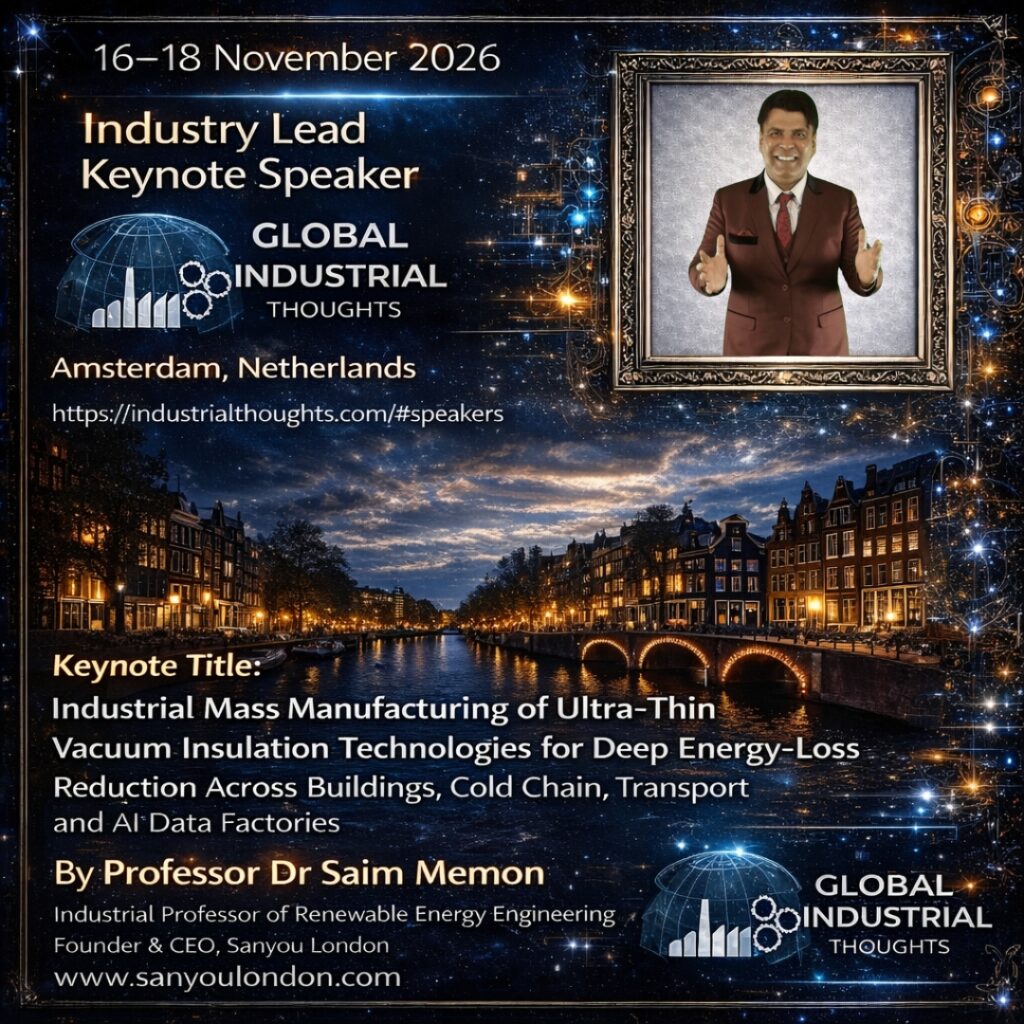
Sanyou London is pleased to share its Industry Lead keynote contribution to Global Industrial Thoughts 2026 in Amsterdam, Netherlands, from 16 to 18 November 2026. The official conference website presents the event as an international platform for professionals, researchers, and industry leaders working across industrial engineering, manufacturing, logistics, automation, sustainability, and energy-related industrial systems, and it also presents Professor Dr Saim Memon among the keynote speakers.
At the conference, Professor Dr Saim Memon, Founder and CEO of Sanyou London, presents a keynote titled Industrial Mass Manufacturing of Ultra-Thin Vacuum Insulation Technologies for Deep Energy-Loss Reduction Across Buildings, Cold Chain, Transport and AI Data Factories.
This is an important industrial message. Why? Because many net-zero discussions still behave as if the biggest challenge lies only in energy generation, while one of the most stubborn and expensive problems remains much closer to the point of use: avoidable thermal loss. Buildings leak energy. Refrigeration systems work harder than they should. Cold-chain packaging and transport barriers lose temperature stability. AI data factories add further pressure through concentrated cooling demand. In all of these settings, the same practical question appears again and again: can thermal loss be reduced deeply, realistically, and at scale?
That is where this keynote becomes especially relevant. It does not present vacuum insulation as a laboratory curiosity. It presents it as an industrial mass-manufacturing platform.
Why does this conference fit the topic so well?
The official conference positioning makes that clear. Global Industrial Thoughts is framed around production systems, operations management, quality engineering, supply-chain optimisation, automation, sustainability, and practical industrial solutions. That is exactly the right setting for a keynote that moves beyond material science alone and focuses on factory control, manufacturing readiness, and deployable product architecture.
In other words, this is not only a talk about insulation performance. It is a talk about whether performance can be manufactured repeatedly, screened properly, traced by batch, qualified against standards, and delivered at a scale that industry can actually use.
What is Sanyou London presenting?
The keynote brings together Sanyou London’s wider industrial portfolio of ultra-thin vacuum insulation technologies, including:
- Vacuum Insulation Panels, VIP
- Decorative Integrated Vacuum Insulation Panels, DVIP
- Vacuum Insulated Wallpaper, VIW
- Vacuum Insulated Curtains, VIC
- Vacuum Insulated Heatable Curtains, VIHC
- Vacuum Insulated Bag or Box systems, VIBB
Together, these technologies reflect a clear industrial aim: to achieve strong thermal resistance in millimetres rather than centimetres, while remaining practical for buildings, logistics systems, refrigerated storage, transportation, and thermally demanding digital infrastructure.
Why is mass manufacturing the real substance here?
Because many technologies fail at the point where industry begins. A concept may work in a controlled experiment, yet still fail in repeatability, sealing reliability, quality assurance, traceability, production rate, or installation practicality. This keynote addresses that gap directly.
The industrial strength of the message lies in its focus on:
- design for manufacture
- scalable lamination and sealing routes
- in-line vacuum and leak screening
- batch traceability
- standards-led qualification
- factory-controlled consistency
That matters commercially. Buyers, developers, contractors, distributors, manufacturers, and industrial partners do not merely need good theory; they need a production outcome they can trust.
Why does this matter across buildings, cold chain, transport, and AI data factories?
Because these sectors share the same hidden penalty: thermal loss becomes operating cost.
In buildings, that means higher heating and cooling demand.
In cold chain, it means shorter hold time, greater refrigeration dependence, and higher payload risk.
In transport, it means more energy input to preserve thermal conditions.
In AI data factories, it means greater cooling burden, higher electrical demand, and tighter thermal-management constraints.
The keynote therefore makes a broader industrial argument: reducing thermal leakage at source improves not only energy efficiency, but also system stability, commercial practicality, and long-term resilience.
Why is this useful for industrial and commercial audiences?
This is where Sanyou London’s position becomes distinctive. The company is not only discussing invention; it is discussing industrial translation. That gives the keynote value for:
- industrial manufacturers
- logistics operators
- architects and retrofit specifiers
- real estate developers
- contractors and installers
- local suppliers and distributors
- cold-chain stakeholders
- data-centre and thermal-management decision-makers
- universities and applied researchers
For these audiences, the real value is simple. A product platform that reduces energy loss is useful. A product platform that reduces energy loss and can be manufactured credibly at scale is much more useful.
Where can readers explore more?
Readers who want the wider technical and commercial picture can explore:
- Department of Products and Sales
- Department of Industrial Research and Development
- What Is a Vacuum Insulation Panel (VIP)? How It Works
- Why Our VIP Is “Smart” Insulation: Best-in-Class Performance in Millimetres
- Flexible Vacuum Insulation Panels: Real Energy Savings for Buildings, Transport, EVs, and Electronics
- VIPs for AI Factories & Data Centres: Thin Thermal Control for Racks, Pods and Control Boxes
- VIBB: Vacuum-Insulated Bag or Box for Medical, Food and Logistics
- Which Vacuum-Insulated Solution Fits Your Project?
Relevant product catalogues are also available here:
- VIP Product Catalogue
- VIW Product Catalogue
- VIC Product Catalogue
- DVIP Product Catalogue
- VIBB Product Catalogue
Final note
Sanyou London sees Global Industrial Thoughts 2026 as an important platform for showing that ultra-thin vacuum insulation is no longer simply a research proposition. It is increasingly an industrial manufacturing proposition.
That is the real significance of this keynote. It shows that deep energy-loss reduction across buildings, cold chain, transport, and AI data factories is not only a technical ambition. It can become a repeatable, quality-controlled, factory-led reality.
For technical discussions, industrial collaboration, product enquiries, distribution interest, or commercial engagement, Sanyou London welcomes contact through its Contact page, its Articles page, and its Videos page.






Share