
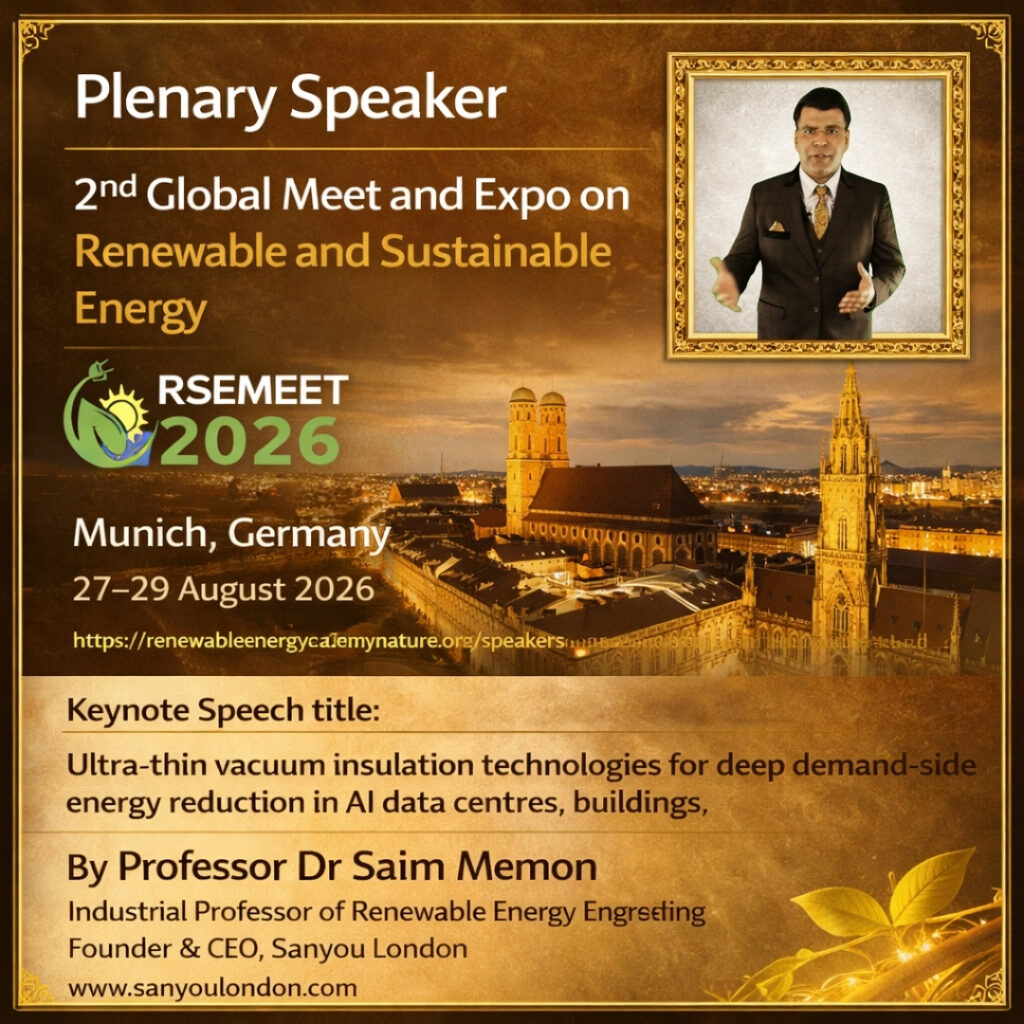
Sanyou London is pleased to share its plenary conference contribution to the 2nd Global Meet and Expo on Renewable and Sustainable Energy, RSEMEET 2026, held in Munich, Germany, from 27 to 29 August 2026. The official event website confirms the Munich venue and dates, while the public speakers page surfaces Professor Dr Saim Memon among the conference speakers. His public speaking, honours, and publications pages also present this engagement as a plenary role at RSEMEET 2026.
At the conference, Sanyou London presents a plenary speech titled Ultra-thin vacuum insulation technologies for deep demand-side energy reduction in AI data centres, buildings, cold-chain storage and transport.
This is an important subject because too much of the net-zero discussion still leans heavily on cleaner generation, while large and avoidable energy losses remain built into the places where heat escapes every day. Buildings continue to lose energy through walls, façades, roofs, glazing and internal weak points. Cold-chain systems lose temperature stability through storage and transport barriers. AI data centres and related digital infrastructure now intensify cooling demand at a pace many energy roadmaps did not fully anticipate. In practical terms, this means demand-side energy reduction is no longer a secondary efficiency measure; it is becoming a core engineering requirement.
Why does this plenary speech matter?
The value of this speech lies in its realism. It does not treat energy efficiency as a vague aspiration. It focuses on one of the most stubborn problems in energy systems: avoidable thermal loss.
Sanyou London’s contribution argues that if thermal leakage is not reduced at source, then everything downstream becomes harder. More generation is needed. More cooling is needed. More infrastructure is needed. More cost and embodied carbon are locked into the system. That is why ultra-thin vacuum insulation matters. It aims to reduce heat transfer where conventional fibrous or polymeric insulation often becomes too thick, too awkward, too space-hungry, or too compromised for the job.
What is Sanyou London presenting?
The plenary speech brings together Sanyou London’s wider portfolio of ultra-thin vacuum insulation technologies, including the Vacuum Insulation Panel, VIP, the Decorative Integrated Vacuum Insulation Panel, DVIP, the Vacuum Insulated Wallpaper, VIW, the Vacuum Insulated Curtain, VIC, the Vacuum Insulated Heatable Curtain, VIHC, and the Vacuum Insulated Bag-or-Box, VIBB.
Together, these technologies show a clear engineering direction: high thermal resistance in millimetres rather than centimetres, with deployment routes that fit real buildings, real storage systems, and real logistics constraints.
Why is this especially relevant to AI data centres?
AI data centres are becoming one of the most strategically important parts of the modern energy discussion. They concentrate heat, power demand, and cooling load in ways that make inefficiency expensive very quickly. That is why the speech’s connection to AI data centres is not decorative; it is technically serious.
If thermal loss can be reduced more effectively around infrastructure, storage interfaces, control enclosures, and supporting systems, then cooling demand can also be managed more intelligently. Readers interested in this wider context may wish to explore VIPs for AI Factories & Data Centres: Thin Thermal Control for Racks, Pods and Control Boxes and the related video Can VIPs Slash Cooling Loads in AI Factories & Data Centres?.
Why do buildings, cold chain, storage, and transport belong in the same conversation?
Because the thermodynamic problem is the same even when the sectors look different. Heat is lost. Temperature drifts. Systems compensate by consuming more energy. What changes is the application, not the physics.
In buildings, this means higher heating and cooling demand. In refrigerated storage and transport, it means more reliance on active cooling, tighter time pressure, and greater payload risk. In logistics, it can mean bigger systems or more energy just to preserve temperature integrity. In all cases, the core opportunity is the same: reduce thermal loss before it becomes a cost, comfort, or carbon problem.
That is why this plenary contribution is commercially and academically useful. It speaks to universities, industrial institutions, architects, contractors, real estate developers, logistics operators, cold-chain stakeholders, local suppliers, and distributors in one connected engineering language.
Where can readers explore more?
Readers who want a deeper technical background can explore:
- What Is a Vacuum Insulation Panel (VIP)? How It Works
- Why Our VIP Is “Smart” Insulation: Best-in-Class Performance in Millimetres
- Flexible Vacuum Insulation Panels: Real Energy Savings for Buildings, Transport, EVs, and Electronics
- VIBB: Vacuum-Insulated Bag or Box for Medical, Food and Logistics
- Which Vacuum-Insulated Solution Fits Your Project?
For direct product information, the following catalogues are also relevant:
- VIP Product Catalogue
- VIW Product Catalogue
- VIC Product Catalogue
- DVIP Product Catalogue
- VIBB Product Catalogue
Final note
Sanyou London sees RSEMEET 2026 as an important platform for showing that serious energy progress does not depend only on producing more energy more cleanly. It also depends on wasting far less of it in the first place.
This plenary speech on ultra-thin vacuum insulation technologies for deep demand-side energy reduction reflects a wider mission: to move high-performance thermal solutions from specialist interest into real deployment across buildings, AI data centres, cold-chain systems, storage, and transport.
For universities, industrial partners, developers, cold-chain operators, architects, contractors, suppliers, and distributors seeking practical next-generation thermal solutions, Sanyou London welcomes enquiries through its Contact page, its Department of Products and Sales, and its wider Articles and Videos pages.






Share