
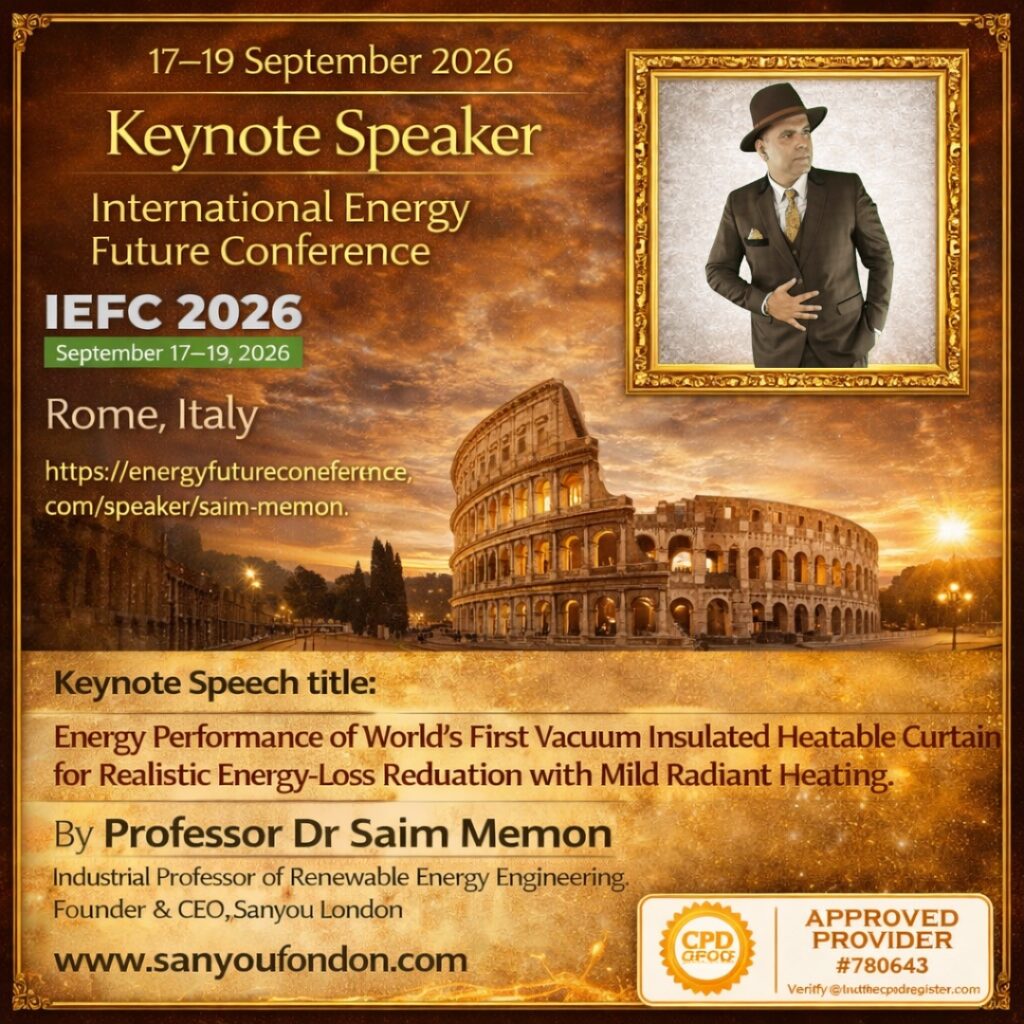
Sanyou London is pleased to share its keynote contribution to the International Energy Future Conference, IEFC 2026, held in Rome, Italy, from 17 to 19 September 2026 as a hybrid event.
At the conference, Professor Dr Saim Memon, Industrial Professor of Renewable Energy Engineering and Founder and CEO of Sanyou London, presents a keynote titled Energy Performance of World’s First Vacuum Insulated Heatable Curtain for Realistic Energy-Loss Reduction with Mild Radiant Heating.
This is an important conference contribution because it addresses a very ordinary but very costly weakness in buildings: heat loss at windows. Too often, this problem is tolerated rather than solved. People compensate by turning up the heating, running systems for longer, or accepting discomfort near glazing lines. In practice, that means energy is wasted not because the whole building is badly designed, but because one common thermal weak point remains unresolved.
That is where Sanyou London’s Vacuum Insulated Heatable Curtain, VIHC, becomes especially significant. The keynote focuses on a solution that does two things at once: it reduces heat loss through windows and provides gentle local radiant warmth where occupants actually feel discomfort most. In simple terms, it is not merely about adding heat. It is about reducing the need for unnecessary heat in the first place.
Why does that matter for the future of energy? Because the energy future is not shaped only by how electricity is generated. It is also shaped by how intelligently energy is used, how much of it is wasted after generation, and whether practical retrofit solutions exist for the millions of buildings that will never receive ideal deep refurbishment. In that sense, this keynote sits naturally within IEFC 2026, whose official theme is “Advancing the Energy Future: Reliability, Affordability, Sustainability.”
The central idea of the keynote is both technically serious and commercially realistic. Traditional fibrous and polymeric insulation can help in many cases, but it often becomes thick, intrusive, or difficult to use where space is limited and retrofit practicality matters. By contrast, Sanyou London’s wider platform of ultra-thin vacuum insulation technologies is designed to achieve high thermal resistance in very compact forms. Within that wider family, the VIHC stands out because it combines vacuum insulation with mild radiant heating in one curtain-format system.
This matters because comfort and efficiency are often treated as separate matters when, in reality, they are closely linked. If people feel cold near a window, they tend to heat the whole room more aggressively. If local comfort can be improved at the window perimeter while the heat loss is also reduced, then the heating system no longer needs to work as hard. That is the practical logic behind the VIHC.
Sanyou London’s wider research and product pathway gives this keynote further strength. The company’s portfolio spans Vacuum Insulation Panels, VIP, Decorative Integrated Vacuum Insulation Panels, DVIP, Vacuum Insulated Wallpaper, VIW, Vacuum Insulated Curtains, VIC, Vacuum Insulated Heatable Curtains, VIHC, and Vacuum Insulated Bag-or-Box systems, VIBB. Together, these technologies reflect a wider mission: deep demand-side energy reduction through solutions that are not only inventive, but manufacturable and usable.
The keynote also has a strong translational message. It is not simply about proving a concept in a laboratory. It is about moving from research to real deployment. That matters for universities, industrial institutions, housing providers, architects, retrofit professionals, contractors, local suppliers, and distributors who do not need theoretical optimism; they need practical technologies that can be adopted without excessive disruption.
For readers who want a fuller technical and commercial picture of the VIHC and its wider family of technologies, the following resources are especially relevant:
Vacuum Insulated Heatable Curtain, VIHC
Vacuum-Insulated Heatable Curtain (VIHC): DIY Warmth and Insulation for ≈1 kWh
Vacuum Insulated Curtain: Thermal Performance & Energy Savings
Which Vacuum-Insulated Solution Fits Your Project?
Will the Vacuum-Insulated Heatable Curtain Warm Your Home for Just 1 kWh?
Department of Products and Sales
Department of Industrial Research and Development
What makes this keynote especially timely is that it speaks to a broader energy truth. The cleanest unit of energy is often the one that never needs to be consumed. If heat loss can be reduced realistically at one of the weakest points in buildings, then energy savings, comfort improvement, and carbon reduction begin to reinforce one another. That is the sort of practical innovation that deserves attention, not only because it sounds new, but because it responds to a problem that people genuinely live with.
Sanyou London therefore sees IEFC 2026 as an important platform for showing that the future of energy is not only about larger systems, new generation capacity, or abstract transition language. It is also about small, intelligent, human-scale interventions that solve real inefficiencies well. The world’s first Vacuum Insulated Heatable Curtain is presented in that spirit: as a realistic, low-disruption, and commercially relevant route to reducing window heat loss while improving local comfort.
For technical discussions, research collaboration, product enquiries, distribution interest, or commercial engagement, Sanyou London welcomes contact through its Contact page and its wider News and Updates, Articles, and Videos pages.






Share