
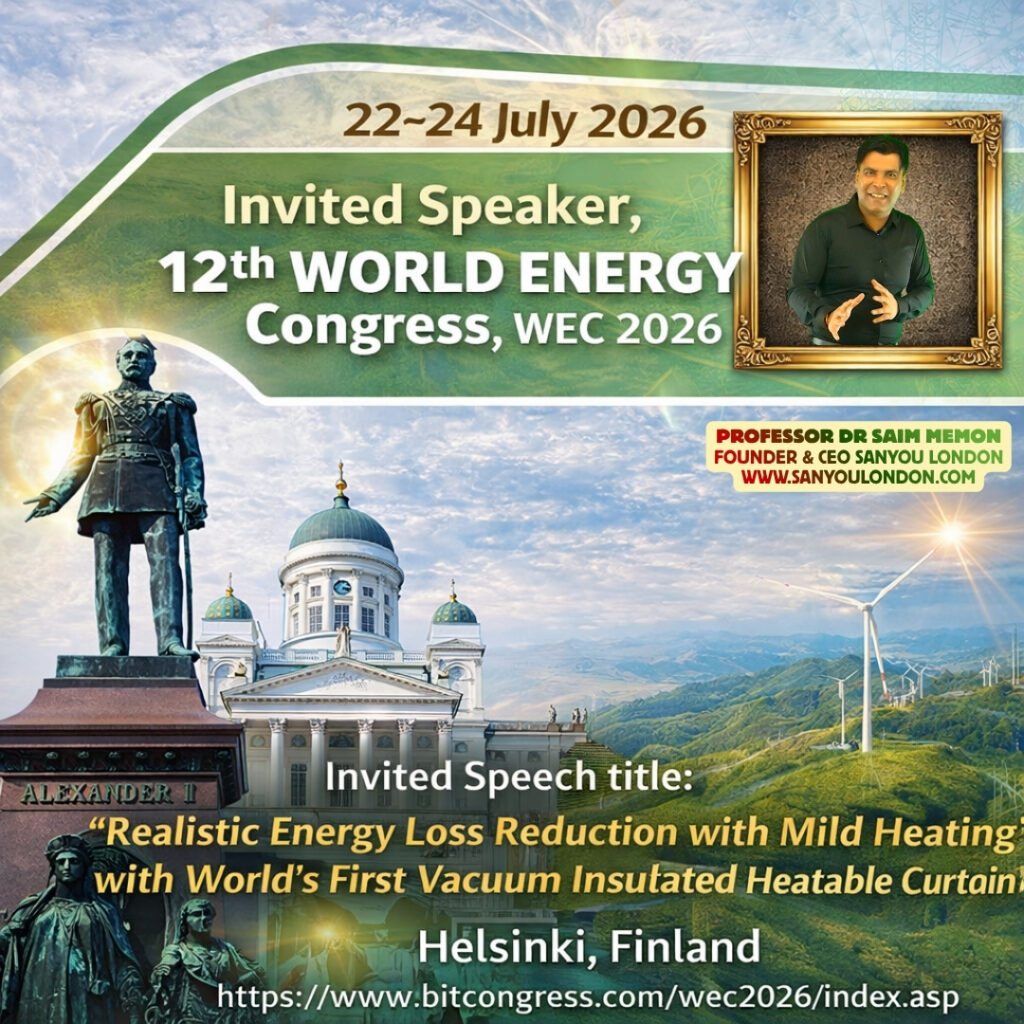
Sanyou London is pleased to share its invited conference contribution to the 12th World Energy Congress, WEC 2026, held in Helsinki, Finland, from 22 to 24 July 2026. The congress presents itself as a global forum for advanced energy technologies, energy storage, and renewable and sustainable energy solutions. Professor Dr Saim Memon presents this engagement on his speaking page as an invited speech at WEC 2026 in Helsinki.
At the congress, Sanyou London shares an invited speech titled Realistic Energy Loss Reduction with Mild Heating with World’s First Vacuum Insulated Heatable Curtain. The title matters because it goes straight to a practical problem that millions of buildings still face: how can energy loss be reduced in a realistic way, without major disruption, without replacing windows, and without forcing people to overheat entire rooms just to feel comfortable near cold glazing?
This is where Sanyou London’s Vacuum Insulated Heatable Curtain, VIHC, becomes especially relevant. Sanyou London describes VIHC as the world’s first vacuum insulated heatable curtain, designed to reduce heat loss, improve indoor comfort, and support energy savings without contractors, scaffolding, or structural changes. The related VIHC article explains that the system combines a 3 mm vacuum-insulation layer with an ultra-thin heating mesh in a 7 mm curtain assembly, giving gentle radiant warmth at roughly 1 kWh for three hours of use.
Why is this speech important?
A great deal of energy policy still speaks in large words, yet many avoidable losses remain painfully ordinary. Heat escapes at windows. Occupants compensate by raising heating demand. Rooms become uncomfortable near glazing lines. Whole spaces are heated more aggressively than they need to be. In that sense, the speech is important because it is not built around fantasy engineering; it is built around an everyday weakness in buildings that still wastes real energy.
Sanyou London’s wider product and knowledge pages frame VIHC and related vacuum-insulated systems as part of a practical route to demand-side energy reduction, especially where space is limited and conventional thick insulation is less attractive. The company’s product pages also place VIHC within a broader family that includes VIC, VIW, VIP, DVIP, and VIBB.
What makes mild heating different from ordinary heating?
The central idea is simple. Instead of pouring more heat into an entire room and accepting ongoing window-side losses, mild local heating near the occupied zone can improve comfort more intelligently when it is paired with strong insulation. That is why the speech is more than a product announcement; it is a challenge to the usual habit of solving discomfort only by increasing energy input.
Sanyou London’s published VIHC and VIC materials support that logic. The company describes VIHC as adding gentle radiant heat to its vacuum-insulated curtain platform, while its related VIC resources describe measurable thermal performance improvements at the glazing line, including a stated U-value of 1.87 W/m²·K and whole-curtain conductivity around 13.1 mW/m·K for the vacuum-insulated curtain platform.
Why does this matter for the wider energy sector?
WEC 2026 is not a niche curtain event; it is a world energy forum. That means the real value of this invited speech lies in the wider lesson it offers. Every avoidable watt of heat loss in buildings adds pressure elsewhere: more generation, more fuel or electricity demand, more strain on grids, and more difficulty in meeting credible climate targets. Reducing loss at source is often more rational than endlessly compensating for it downstream. The official congress description places WEC 2026 within exactly that broader energy conversation by emphasising advanced technologies, energy storage, and renewable and sustainable energy solutions.
For Sanyou London, this is why VIHC should not be seen in isolation. It sits within a broader industrial R&D platform focused on ultra-thin vacuum insulation technologies for buildings, cold chain, transport, and thermal-management applications. The company’s Department of Industrial Research and Development highlights specialised experimental capability for electrical and thermal performance research, while the Department of Knowledge Exchange and Impact presents VIHC as a product aimed at combining vacuum insulation with controlled surface heating for improved indoor environmental performance.
What should readers explore next?
Readers who want the fuller technical and commercial picture can explore:
- Vacuum Insulated Heatable Curtain, VIHC
- Vacuum-Insulated Heatable Curtain (VIHC): DIY Warmth and Insulation for ≈1 kWh
- Vacuum Insulated Curtain: Thermal Performance & Energy Savings
- Which Vacuum-Insulated Solution Fits Your Project?
- Will the Vacuum-Insulated Heatable Curtain Warm Your Home for Just 1 kWh?
- Can Vacuum Insulated Curtains Cut Window Energy Loss by up to 33%?
These resources help show that the real interest here is not novelty for its own sake. The real interest is whether a thin, practical, manufacturable product can reduce glazing-related energy loss and improve comfort in a way that people can actually adopt.
Final note
Sanyou London sees WEC 2026 as an important platform for showing that serious energy progress often starts with ordinary losses that have been tolerated for too long. The invited speech on the world’s first Vacuum Insulated Heatable Curtain brings that point into focus. Instead of waiting for perfect future systems, it asks a more useful question now: how much energy can be saved when insulation and mild heating are combined intelligently at one of the weakest points in a building?
For universities, industrial partners, real estate decision-makers, architects, contractors, suppliers, and distributors who want practical next-generation solutions in thermal comfort and energy saving, Sanyou London welcomes enquiries through its Contact page and broader Department of Products and Sales.






Share