
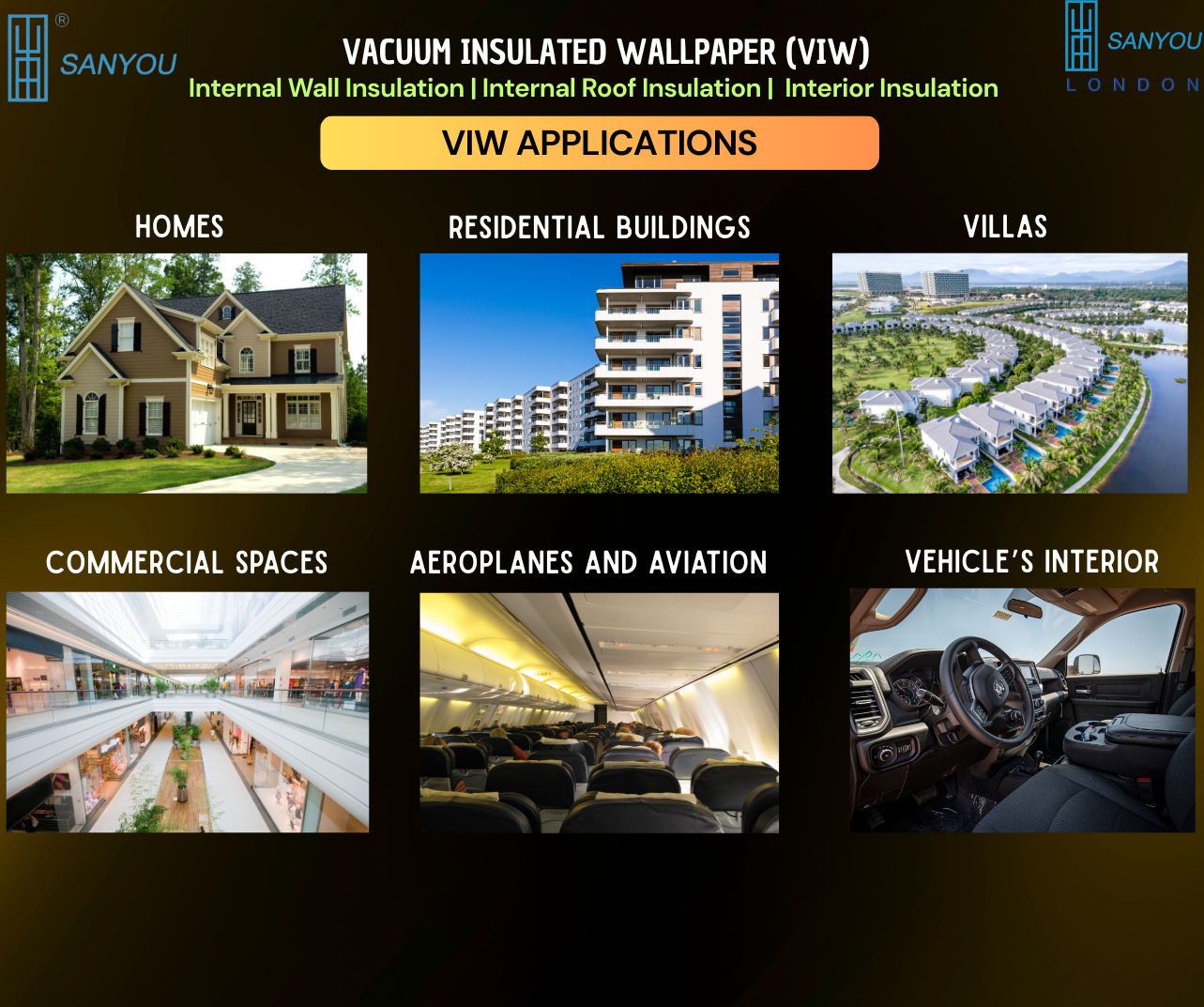
VIW applications, done properly—rooms, sectors and real-world fit-outs
Vacuum-Insulated Wallpaper (VIW) is not just a domestic gimmick; it is a thin, engineered lining that lifts comfort, trims energy loss and calms noise in places where bulk insulation is impractical or unaffordable. Below is a practical map of where VIW makes sense—and how to apply it so the benefits show up on the meter, in user comfort, and on the balance sheet.
1) Homes and residential buildings
Living rooms
- Pain points: cold external walls behind sofas; late-afternoon heat on west elevations; condensation shadowing behind furniture.
- VIW placement: full wall behind seating and media; returns into short reveals; targeted strips on chimney-breast wings.
- Outcome: warmer internal surface temperatures; gentler evening peaks; fewer mould complaints in stagnant corners—without stealing floor space or upsetting skirtings.
Bedrooms
- Pain points: radiant chill at bed heads; traffic noise on street façades; draught sensation at reveals.
- VIW placement: bed-head wall plus reveal returns; optional strip behind wardrobes.
- Outcome: night-time comfort at a lower thermostat set-point; audible quietening from reduced airborne transmission through the treated wall.
Kitchens and bathrooms
- Pain points: cold spots near external walls; condensation risk after cooking or showers.
- VIW placement: field of wall outside splash zones; behind tall units and utility runs; avoid direct, high-temperature appliance flanks.
- Outcome: fewer dew-point incidents; steadier temperatures around cupboards; wipe-clean faces simplify upkeep. Use strong extraction as usual.
Apartments and rentals
- Why VIW helps: thin, semi-permanent lining improves comfort and operating costs without knocking back floor area. Landlords can target perimeter rooms first; tenants feel the difference quickly.
2) Offices, retail, hospitality—commercial interiors
Open-plan offices
- Pain points: perimeter glare and temperature swings; cold edges near glazing; distracting noise from traffic or plant.
- VIW placement: perimeter walls at workstations; meeting-room partitions facing unconditioned voids; reveals around large windows.
- Outcome: tighter internal temperature band; lower fan speeds from reduced heat gain/loss; perceptibly quieter edges.
Retail stores
- Pain points: cold aisles along external walls; hot spots near west façades; chiller cases fighting background heat.
- VIW placement: behind gondolas and feature walls; back-of-house areas; around back-to-back cold rooms (on the shop side).
- Outcome: calmer shopper comfort; easier temperature control for perimeter refrigeration; less condensation on cold-adjacent plaster.
Restaurants, cafés and hotels
- Pain points: draughty banquettes against façades; noise spill from streets; thermal discomfort in corner rooms.
- VIW placement: dining-zone feature walls; guest-room bed heads and window reveals; corridors facing outside.
- Outcome: quieter ambience; better evening comfort without cranking the HVAC; decorative finishes that match brand palettes.
Fit-out note: VIW arrives with a finished face; choose matte, satin or patterned surfaces to align with brand standards. Cleaning uses mild, non-abrasive agents—ideal for hospitality and retail housekeeping.
3) Villas and premium residences
- Design first: villas demand aesthetics and comfort in equal measure. VIW’s custom faces—stone-look, timber-grain, textile textures—maintain the design language while delivering a thermal function.
- Where it shines: double-height spaces with show walls; gallery corridors on external edges; home cinemas needing quiet walls without thick acoustic builds.
- Climate logic: in hot-arid regions, VIW slows late-day heat ingress; in cooler seasons or locations, it lifts mean radiant temperature at seating, letting residents run a lower thermostat comfortably.
4) Aircraft cabins and transport interiors
Aircraft cabins (concept to certification pathway)
- Use case: lightweight lining for localised hot-spot damping and acoustic calming behind PSU panels, seat-row monuments, sidewall panels and crew-rest partitions.
- Why VIW: high thermal resistance in millimetres; potential for audible quietening on treated sections; minimal weight penalty relative to added performance.
- Practicalities: variants can be engineered to meet aviation flammability and smoke/toxicity requirements for interior materials; final selection and approvals sit with the OEM and regulator.
- Outcome sought: reduce skin-temperature swings on sun-side fuselage sections; improve crew and passenger comfort with targeted, thin retrofits during cabin refreshes.
Road vehicles and rail interiors
- Use case: thin thermal and acoustic lining behind door cards, headliners, quarter panels, bulkheads in vans and minibuses; passenger-compartment separators in taxis and LCVs.
- Why VIW: keeps packaging volumes unchanged; trims HVAC load; softens hot-soak recovery.
- Outcome: quieter, more stable cabins; incremental range and comfort gains in electric vehicles; less HVAC runtime in taxis and ride-hail fleets.
Integration note: transport interiors require fixings outside the vacuum zone, compatible adhesives, and assembly-level fire performance. We support design-in with CAD, fixing maps and material compatibility guidance.
Quick application matrix (copy straight into a brief)
| Sector | Typical pain point | VIW placement | Immediate win |
|---|---|---|---|
| Homes – living room | Cold external wall behind sofa | Full wall + reveal returns | Warmer surface; less radiant chill |
| Homes – bedroom | Street noise; cold bed head | Bed-head wall | Quieter nights; lower set-point |
| Office | Perimeter discomfort | Perimeter fields, meeting-room partitions | Smaller temperature swing; calmer edges |
| Retail | Cold aisles; hot west wall | Behind gondolas; feature wall | Better shopper comfort; easier refrigeration |
| Restaurant/Hotel | Draughty façades; noise | Dining feature wall; guest-room reveals | Quieter ambience; better evening comfort |
| Villa | Aesthetic walls; comfort | Double-height feature walls; galleries | High-end look; thermal function |
| Aircraft cabin | Localised hot spots; noise | Sidewalls, monuments (variant) | Smoother cabin temperatures; quieter sections |
| Vehicle interior | HVAC strain; hot-soak | Headliner, door cards, bulkhead | Faster cool-down; quieter cabin |
Practical fit-out guidance that keeps results honest
- Continuity beats area: wrap VIW into short returns and around corners; skipping edges undermines the gain.
- Moisture first: fix sources of damp or leakage before lining; VIW lifts surface temperatures but is not a damp-proof course.
- Fixings strategy: do not drill through VIW. Mount shelves, TVs and artwork on independent rails or untreated zones planned in the layout.
- Cleaning and wear: choose faces matched to usage—wipe-clean for kitchens and retail; scratch-resistant options for corridors and hotel rooms.
- Fire and compliance: interiors are assessed at assembly level; we provide notes to help you select finishes that satisfy your local code for the room type.
Measurement and verification—prove it worked
- Before/after thermography on a comparable weather evening to visualise warmer surfaces and tighter temperature bands.
- Spot metering of space heaters or HVAC runtime for a fortnight either side of installation.
- Acoustic snapshot with a smartphone meter to record a simple decibel reduction at a consistent time of day on treated façades.
Short, credible evidence helps facility managers, landlords and homeowners justify wider rollout.
Procurement, customisation and delivery
- Formats: standard 200 × 200 mm modules; project-specific shapes for arches, reveals and socket surrounds.
- Faces: colour-matched solids; textile-like textures; stone and timber effects for villas and hospitality; paint-ready faces on request.
- Packs: room-by-room kits with layout diagrams, joint trims or colour-matched sealant, and a simple install guide.
- Lead times: sized to order; phased deliveries available to suit live-building programmes.
Why VIW belongs in your next specification
- Slim build-ups preserve layouts and rental value.
- Fast installs reduce downtime in shops, cafés and offices.
- Decorative freedom means no compromise between look and function.
- Transport-friendly variants extend the logic to cabins and cabins-on-wheels.
Talk to us about your rooms, vehicles or cabins
For tailored advice, sample packs, and pricing:
- Contact our Customer Service Team to discuss your rooms, elevations or interior modules.
- Prefer a direct conversation? Email or phone Professor Saim Memon—we can review sketches or photos and recommend a sequence that delivers the biggest return first.
- Explore specifications, purchasing process, videos and FAQs at www.sanyoulondon.com.
Design the look you want; keep the comfort you need. With VIW (Sanyou London) you can have both—in homes, workplaces, villas and even in the sky.






Share

Author
Prof. Dr. Saim Memon
PhD, CEng, FHEA, MSc, BEng(Hons), PGC-TQFE, GTCS, MCMI, MIET, MIEEE, MInstP, IBPSA, APCBEES, MPEC
CEO | Industrial Professor | Inventor | British Scientist | Chartered Engineer | Qualified Teacher | Chief Editor | World Speaker | Pioneer in Vacuum Insulation Energy Technologies